


Food noise is the constant chatter about food that isn't hunger. Here's what research says drives it, why it gets louder on a diet, and what helps turn it down.
It's 3:40 on a Tuesday afternoon. You ate lunch. You weren't even especially hungry. And yet some part of your brain has been running a quiet, persistent commercial for the leftover birthday cake in the break room for the better part of an hour.
That running commentary has a name now: food noise. Food noise is the constant, intrusive stream of thoughts about food (what to eat, when to eat, whether you "should" eat) that keeps playing whether or not your body actually needs fuel. Researchers describe it as heightened or persistent reactivity to food cues, and the good news is that it isn't a character flaw, it isn't the same thing as hunger, and there are everyday things that tend to turn the volume down. If you're using the Healthi app, this is a good week to notice when the noise shows up in your day, because the timing usually tells you something.
Let's talk about what's going on in there, and what helps.
The term started as something patients said out loud, not something scientists wrote down. People described it as a radio they couldn't switch off. In 2023, a group of researchers took that language seriously and proposed a working definition: food noise is a heightened or persistent form of food cue reactivity, the brain's response to seeing, smelling, remembering, or just thinking about food, which often shows up as food-related intrusive thoughts, according to a review published in Nutrients.
Here's what's interesting about that framing. A food cue can be external (the bakery smell, the donut box, the ad) or internal (a stray thought, a memory of how good that pasta was). Your brain reacts to both. And the strength of the reaction isn't fixed; the same review lists factors like sleep, stress, time of day, your mood, and even where you are that can shift it up or down.
So when the noise feels louder some days than others, you're not imagining it. Your brain really is more reactive on some days, and that's a clue rather than a verdict.

A lot of people notice that the moment they decide to "be good," food gets loud. This feels like a cruel joke, but it makes a certain sense.
Part of it is attention. When you're paying closer attention to food, you notice more food. Part of it is scarcity: when a food goes on the mental "not allowed" list, it tends to get more interesting, not less. And part of it is biology that has nothing to do with willpower. The Nutrients review notes that people with a higher body weight tend to show stronger food cue reactivity, and that chronic stress and food insecurity are associated with more of it. None of that is a choice you made. (If stress is your particular amplifier, we've unpacked the hidden ways stress affects weight loss separately.)
There's also a time-of-day piece. The same review points to evening as the period when preoccupation with food tends to peak. If your days are calm and your evenings are a negotiation with the pantry, that pattern is common enough to have shown up in research. You're in good company, and the solution probably isn't "try harder at 9 p.m."
This is worth sitting with for a minute, because they feel similar from the inside.
Hunger tends to build gradually, is open to a range of foods, and gets quieter after you eat something satisfying. Noise tends to arrive suddenly, is weirdly specific (not "food," but "the sour cream and onion chips in the cabinet"), and often keeps going even after a reasonable meal. Hunger is a signal from your body. Noise is more like a signal about your environment and your state of mind.
A gentle question some people find useful: "Would an apple do right now?" If the answer is a sincere yes, that's probably hunger, and eating is the right call. If the answer is "no, it has to be the chips," that's useful information too. Not a reason for guilt, just a sign that something other than your stomach is talking.
Ever notice which one you're hearing most often? That alone can change how you respond to it.
If there's one factor that reliably cranks the volume, it's sleep. In a study published in Nature Communications, researchers scanned the brains of healthy adults after a normal night of sleep and again after a night without it. Sleep deprivation dampened activity in the frontal regions that handle complex decision-making and amplified the deeper reward centers, and the sleep-deprived participants rated high-calorie foods as significantly more desirable.
In daily-life terms: the version of you that's running on five hours is not making the same decisions as the rested version, and it isn't because you've gotten lazier overnight. The part of your brain that says "we're fine, we don't need that" is literally quieter, and the part that says "ooh, that" is louder. That's a mechanical explanation for something that usually gets blamed on character.
If your food noise spikes after bad nights, that's one of the most fixable patterns there is, and it has nothing to do with food. We've written more about how rest shapes your goals in The Power of Sleep.

Here's a study that surprised a lot of people. In a tightly controlled NIH trial published in Cell Metabolism, 20 adults lived in a research unit and spent two weeks on a menu of ultra-processed foods and two weeks on a menu of minimally processed foods. The two menus were matched for calories, sugar, fat, fiber, and sodium offered, and people could eat as much or as little as they wanted. On the ultra-processed menu, they ate about 508 more calories a day on average and gained roughly 0.9 kg (about 2 pounds) in two weeks. On the minimally processed menu, they lost about the same amount.
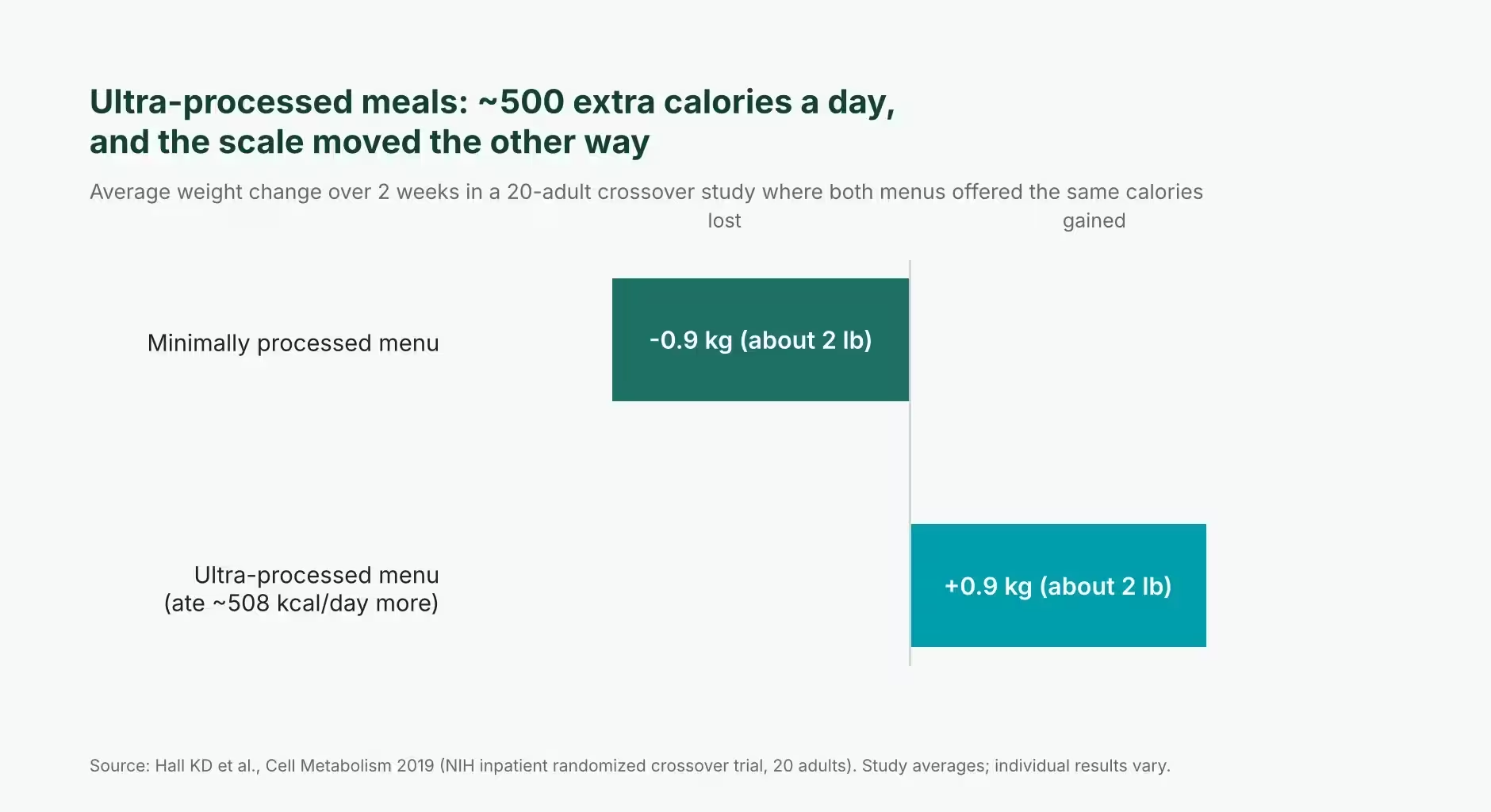
Nobody in that study was weak-willed on week one and disciplined on week three. The food changed, and the eating followed. That's a helpful thing to remember when you're tempted to treat food noise as a personal failing: some foods are built to be easy to keep eating, and your brain is responding exactly as designed.
The flip side is that meals built around protein and fiber tend to hold you longer. A review in the American Journal of Clinical Nutrition describes higher-protein eating patterns as supporting fullness and helping with weight management. In plain terms, a lunch of eggs, beans, or chicken with vegetables usually buys you a quieter afternoon than a lunch of crackers and a granola bar, even at the same calories. If you want ideas, we have a whole post on building snacks that actually keep you full.
There's no switch, but there are dials, and most of them are small. A few that people come back to:
You might try one of these for a week, not all four. The goal isn't silence. It's a volume you can live with.
You've probably heard people on semaglutide or tirzepatide say the noise "just stopped." Those reports are real, and researchers think these medications may act on reward pathways in the brain, not only on appetite, according to the same Nutrients review. The authors are also clear that the evidence here is still mostly anecdotal, and that medication works best alongside nutrition, movement, and support rather than instead of them. If you're curious about how that side of things works, our sister blog has a thoughtful piece on GLP-1 medicines, food noise, and emotional eating. For a lot of people, the dials above are the whole toolkit, and that's a perfectly good place to be.
And if you’re wondering whether a GLP-1 could be one helpful part of your own plan, HealthiCare makes it simple to get started. Complete an online visit, connect with a licensed clinician, and get personalized guidance on whether treatment is right for you. Explore GLP-1 care with HealthiCare.
If you've spent years assuming the constant food chatter meant something was wrong with you, it might be a relief to learn that it's a response, not a verdict, and that it moves with sleep, stress, what you ate at lunch, and what's sitting on the counter. You don't have to win an argument with your brain every afternoon. You just have to make the argument happen less often.
If you'd like a hand spotting your own patterns, the Healthi app makes it easy to see when the noisy moments cluster, and our coaches have heard every version of "I can't stop thinking about the cake." Start with one dial this week. The cake will still be there, and it will be a lot less chatty.
This article is for general information and isn't a substitute for medical advice. If you're considering a medication for weight management, talk with a licensed provider.
October 15, 2026