

How many steps do you need in a day to lose weight? Research points to about 7,000 for health and 8,000-8,500 to keep weight off. Here's where 10,000 came from.
Ten thousand steps a day was never a medical recommendation. As far as anyone can tell, it started in 1965 as the name of a Japanese pedometer, the manpo-kei, which translates roughly to "10,000 steps meter," and the number stuck because it was round, memorable, and printed on the box (Harvard Gazette).
So how many steps a day do you actually need to lose weight? There's no single magic number, but the research points to a surprisingly reachable range: around 7,000 steps a day is where most of the big health benefits show up, and people who keep weight off after losing it tend to land near 8,000 to 8,500 steps a day. More helps a little; it just helps less than you'd think. If you're using the Healthi app, this is a nice week to glance at your activity log and notice what your real, ordinary number is, because that's the only honest place to start from.
Let's talk about where the numbers come from, and what they mean for a regular Tuesday.

It isn't wrong, exactly. It's just arbitrary. When researchers finally went looking for evidence behind the number, what they found was that the benefits of walking don't flip on at 10,000. They climb steadily from a very low baseline and then flatten out well before that.
A 2019 study in JAMA Internal Medicine followed nearly 17,000 older women, average age 72, wearing activity monitors. The least active group averaged about 2,700 steps a day. Women averaging around 4,400 steps had a 41% lower risk of dying over the follow-up period, and the benefit kept growing until about 7,500 steps, where it leveled off. Walking pace didn't matter once step count was accounted for (Harvard Gazette).
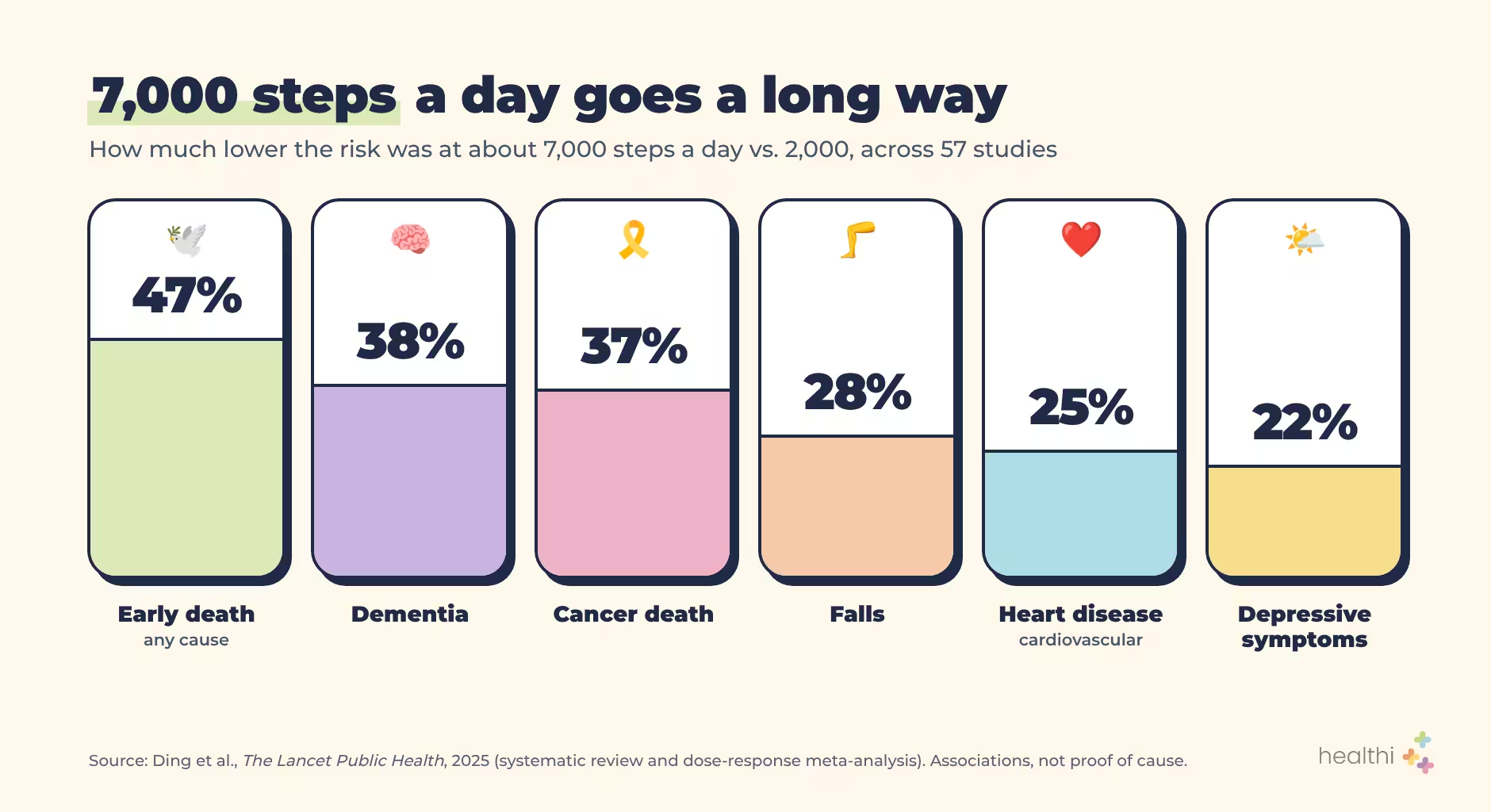
Then in 2025, a much larger analysis in The Lancet Public Health pooled 57 studies across eight health outcomes. Compared with 2,000 steps a day, people walking about 7,000 had a 47% lower risk of early death, 25% lower risk of cardiovascular disease, 38% lower risk of dementia, 22% fewer depressive symptoms, and 28% fewer falls. Beyond 7,000, the extra gains were, in the authors' words, modest (Ding et al., Lancet Public Health 2025).
Here's what's reassuring about that. If you've ever closed your step app at 6,200 feeling like you'd failed, the science was never on the app's side. You were already most of the way to the good stuff.
This is where it gets more honest and a little less tidy. Those big studies measured things like heart disease and longevity, not pounds. Steps alone are not a particularly efficient way to create a calorie deficit; a walk around the block burns less than most people hope, and it's easy to eat that back without noticing. The reason walking still matters so much for fat loss is that it's the kind of movement you can do every single day without needing to recover from it.
The clearest data on steps and body weight came out in 2026. Researchers at the University of Modena and Reggio Emilia pooled 14 randomized trials with 3,758 adults in lifestyle programs that combined diet advice, behavior strategies, and step tracking. People averaged about 7,280 steps a day at the start and roughly 8,450 by the end of the weight-loss phase, losing about 4.4% of their body weight. What stood out was the maintenance phase: each extra 1,000 daily steps above baseline was linked to about 1% more weight loss kept off, and the authors suggested roughly 8,500 steps a day as a working target for keeping weight from creeping back (Saadeddine et al., Int J Environ Res Public Health 2026).
Notice the shape of that finding. Walking more didn't predict how much people lost while dieting. It predicted whether they kept it off. That matches what a lot of people figure out the hard way: the eating part drives the loss, and the moving part is what makes the loss stick.
If you're currently at 3,000 steps a day, which is roughly what a desk job plus a car commute adds up to, the jump to 7,000 is a real change in your life, and it's also where the steepest benefits live. If you're already at 9,000, pushing to 12,000 will do a little, but you may get more from protecting your sleep or adding two short strength sessions a week, which the HealthiCare team has written about for people losing weight on GLP-1s.
A good question to sit with: what's your actual average over the last two weeks, not your best day? Most phones already have this number tucked away. A lot of people are surprised in both directions. Some discover they're already at 6,500 without trying. Others find out that a "pretty active" week was mostly standing in a kitchen.
Ever notice how a step goal feels either like a gold star or a verdict, with nothing in between? If the number you choose makes you feel like you're failing most days, it's the wrong number, regardless of what any study says. The best target is the one you'll hit on a bad week, not just a good one. That's the same logic behind what consistency actually looks like: it's the floor that matters, not the ceiling.
Picture a weekday that already includes work, dinner, and some version of a couch. Adding 2,000 steps sounds like a project, but in practice it's about 15 to 20 minutes of walking, and it doesn't have to be one walk. A ten-minute loop after lunch, parking at the far end of the lot, a quick walk while a phone call happens, and carrying laundry up one flight at a time all count, and nobody has to put on special clothes for any of it.
One thing a lot of people find helpful is attaching the walk to something that already happens, like the end of a meal. A ten-minute walk after dinner has the bonus of changing what the evening feels like; it's harder to drift back into the kitchen when you've just put your shoes away. Others prefer a single longer walk in the morning and then stop thinking about it. There's no evidence that splitting it up or doing it all at once matters much for the total. What matters is that it happens on Thursday, when you're tired.
If you'd like a number to aim at, 7,000 is a good first destination for most people, and somewhere around 8,000 to 8,500 is a reasonable place to settle once you're there. If you track your meals in the app alongside your movement, you'll probably notice the two reinforce each other: on days you walk, logging feels easier, and on days you log, you're a bit more likely to walk. That isn't magic. It's just attention, pointed in a friendly direction.
Walking more and seeing the scale hold still for a couple of weeks is one of the more discouraging combinations in weight loss, and it's also normal. Muscle, water, sodium, sleep, and the timing of your last meal all nudge that number around far more than one week of extra walking can. The scale is a lagging, noisy indicator; your step count is a direct one. If you're moving more than you were a month ago, something good is happening whether or not the scale has gotten the memo.
And remember what the research is actually promising. Nobody in those studies lost weight because of their pedometer. They lost it by changing what they ate, and they kept it off, in part, because they kept walking. That's a long game, and it's a kind one. It doesn't ask you to be impressive. It asks you to be out the door.
If you want a hand finding your real baseline and building from there, the Healthi app keeps your food, your movement, and your week in one place, and our coaches have cheered on more 6,000-step days than you'd believe. Start with whatever today's number is. Tomorrow, add a loop.
This article is for general information and isn't a substitute for medical advice. If you have a heart condition, joint pain, or another health concern, talk with your provider before changing your activity level.
November 6, 2026